French ski slopes gave architects a
platform to build boldly
Modern techniques and pioneering ideas
defined many of the ski resorts built in the 1960s and 70s in France, with
some even classified as historic monuments
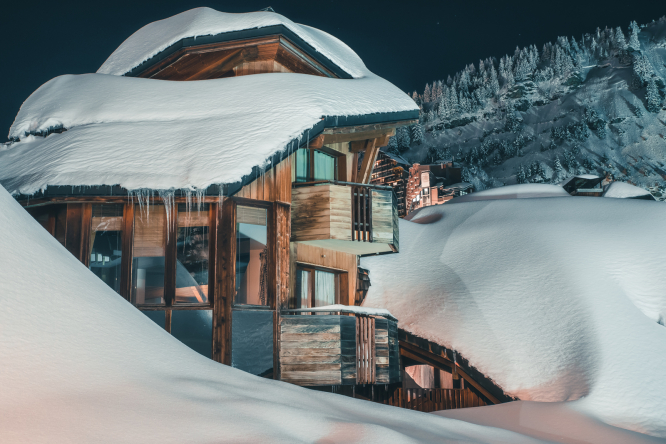
Avoriaz
By Jane Hanks – The Connexion
Many of the French ski resorts built in
the 1960s and 70s are now regarded as examples of pioneering architecture.
They were constructed during the Trente Glorieuses, a period of unprecedented economic
growth after World War Two when resorts were developed on virgin territory,
giving architects freedom to be creative. There were new materials, new money and new ideas.
Flaine, at Arâches-la-Frasse in Haute- Savoie, was
built in the Bauhaus style and is famous for its open-air sculptures by
renowned artists including Picasso.
The founders were two great patrons of
the arts in the 20th century, Eric and Sylvie Boissonnas, who wanted to play a role in the expansion of
winter sports and the reconstruction of France. They found the site in 1959 and
brought in well-known modernist architect Marcel Breuer who, on his first
viewing, said: “What a wonderful site! How do we avoid spoiling it?”
He was determined to use modern
techniques, but at the same time respect the natural relief lines and beauty of
the surrounding landscape, and he made the centre car-free.
He used relief on the facades, shaped
like the points of a diamond, so that the sun’s rays would strike at different
angles to produce reflections of contrasting intensity.
One of the resort’s most famous
buildings is Le Flaine hotel, with a daring terrace extending beyond the cliff
edge, hanging in space.
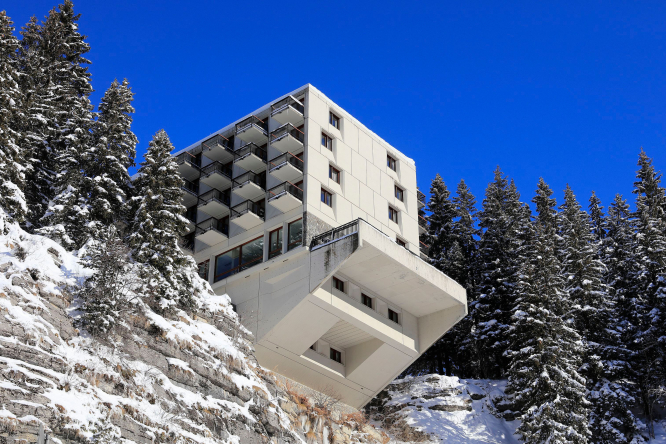
Le Flaine’s overhanging hotel
The project was dreamt up in the 1960s
by a local mountain guide, Robert Blanc, and entrepreneur Roger Godino.
They hired architect Charlotte Perriand, who had been brought up in the Savoie mountains. She was an associate of Le Corbusier and
at the peak of her career in Paris at a time when there were very few women in
the profession.
Her aim too was to make a car-free
resort which would blend into the landscape, and so her buildings lean into the
slopes, rather than towering above them. In one of the early ones, the front
walls are tilted back so that each level of apartments receives an equal amount
of sunlight. At the back, there is the same slope in reverse, and large windows
to reflect light from the snow.
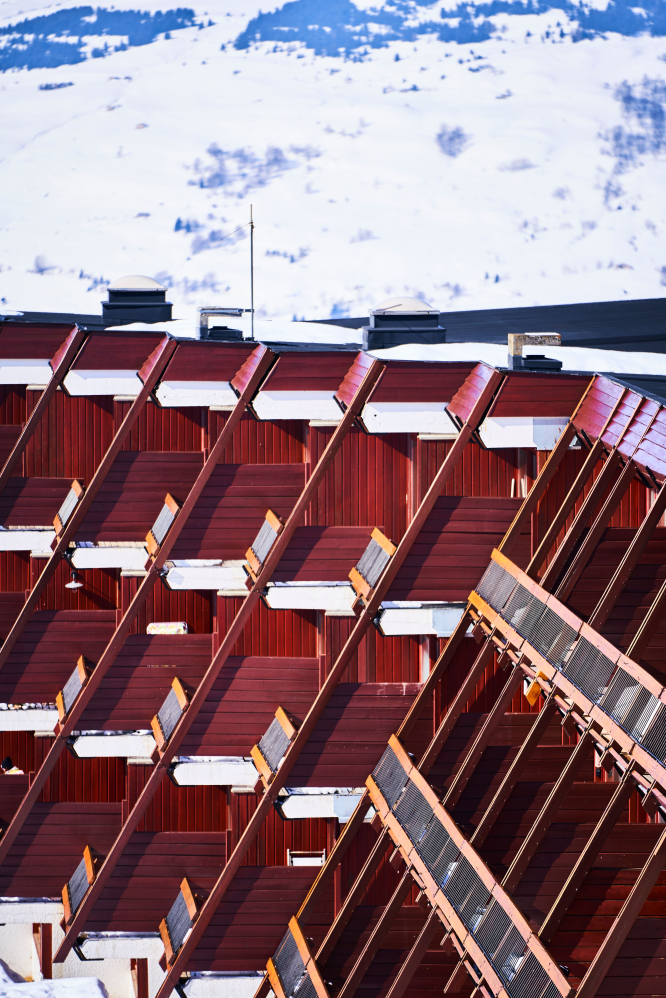
Buildings at Les Arcs lean into the ski
slopes to blend in better
The layout of rooms was important to Ms Perriand, who designed them to suit the needs of the people
living in them.
They were open-plan
with kitchens separated from the sitting room by a bar rather than a wall, so
that the person cooking did not feel left out.
Avoriaz in the commune of Morzine,
Haute-Savoie, was also ahead of its time. Jean Vuarnet,
a local Olympic ski champion, discovered the site and by 1963 he had already
organised the building of a ski-lift which connected Morzine
in the valley to the plateau above.
Entrepreneur Gérard Brémond,
who later founded the holiday company Pierre & Vacances, was interested and brought with him three young architects from
Paris – Jacques Labro, Jean-Jacques Orzoni and Jean-Marc Roques.
'Innovative
on so many levels'
Mr Labro, now
85, is still in contact with the current team of architects at Avoriaz, led by Simon Cloutier.
“The original resort was innovative on
many levels,” says Mr Cloutier.
“As in Flaine and Les Arcs, Jean Vuarnet was determined the resort should be car-free. This
made it difficult to attract investors as at that time Georges Pompidou was in
power and promoting the idea of bringing cars into towns and widening roads to
make it possible.
“Making the resort car-free also meant
the 20,000 tourists it catered for had to be housed close together in large
buildings rather than spread out in chalet-type accommodation, so no one had to
walk too great a distance. At Avoriaz, everything is
designed so you can move around not just on foot, but entirely on skis.”
Wood was used to help blend the resort
into the landscape. Red cedar shingles cover the buildings. They are long-lasting,
need no treatment and fade to grey to merge naturally into the background.
'Urban-scale development had never existed before this in
the mountains'
“The architects did not want to
create square shoebox buildings, but to integrate them into the landscape.
However, curves meant there might only be one or two apartments on the top
floor" says Mr Cloutier.
“We have to credit not only the
architects, but also the investors with the courage they required to finance a
building with a lift right to the top floor, which only served perhaps one
apartment. The chosen shapes are not just aesthetic but practical, to make
sure, for example, that each window has a view.”
He says the young architects from Paris
were remarkable. They had no experience of snow and freezing temperatures but
introduced ideas we now take for granted.
“They were early ecologists, though they
did not know it. The main structure is in concrete, but with an outside layer
of insulation covered in wooden shingles, wrapping the main structure in an
‘overcoat’. This had never been seen before.
“The balconies are separate
constructions so the cold temperatures they attract are not transferred into
the main building.
“The concrete roofs are flat with, above
them, a separate layer of wood where the snow never melts – an idea taken from
local traditional farmhouses which used snow as a layer of insulation.”
Mr Cloutier started working in Avoriaz in 1996 and took over as the head of Atelier d’Architecture d’Avoriaz from Mr Labro in 2007. Pierre & Vacances is still the owner.
“There is a sense of continuity, and the
earliest constructions are still a source of inspiration,” he says.
“From the very beginning, a great deal
of thought went into the resorts, using ideas well ahead of their time.
“It was an unprecedented chance for
young architects to shine.”